






Because everything in nature seems to die off in the winter - if it doesn't hibernate or go south to Egypt for the season - it is often assumed that it's a waste of time to try to do any bird-spotting at this time of year.
Absolute rubbish! There are simply hundreds of bird species out there in your garden, just waiting to be identified. The fact that they are all indistinguishable from each other only makes it more of a challenge!
But to make things easier for the newcomer to winter-time bird-spotting, I have re-categorised all known birds into only ten different species, and I will be bringing you the full list today and tomorrow. This means that every bird you see in your garden in the next two months is guaranteed to fit into one of the following categories, and that means you no longer have to rummage around in your bird book, trying to choose between dozens of near-identical birds, and saying to yourself doubtfully, ‘Well, I suppose it could be a young female fieldfare if the colour was a little lighter and it were six inches longer and turned round a bit so I could see its profile better ... ‘
Don't you hate bird-spotting like that? Don't you wish it were simpler and nicer? Of course you do! Here we go, then, with the only ten birds you will see in your garden this winter!
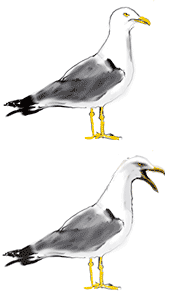 1. The Land Gull. Ornithologists persist in referring to a bird called the "sea gull " although they know perfectly well that hardly a single gull has been spotted at the seaside in the last ten years. These nasty, white, vicious creatures have been lured inland by the presence of ever larger sewage farms, refuse dumps and landfill sites, and instead of nobly skimming the waves in search of fish, they now scrabble among the rubbish in search of old kipper bones. With persistence and patience, they can still be trained to follow behind ploughs and tractors in the traditional picturesque fashion, but most modern farmers haven't the time to devote to the training sessions involved, especially as land gulls now have such bad breath. It used to be said that if gulls came to your garden, it meant there was a storm at sea. It now means that the local city dump is closed for the morning.
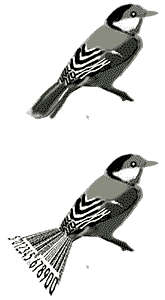 2. The Barcode Tit. Even experts find it difficult to tell one tit from another, owing not only to their similarity, but their infuriating habits of hanging upside down, flying faster than the speed of sight, etc. It is now slowly being realised that the black and white lines on their tails form different bar-codes, according to the type of tit, and that if you can get close enough, you can pass your electronic bar-code reader over it and get an instant read-out. If your bar-code reader doesn't work, you can either ring a bell and wait hours and hours for the supervisor to come, or turn to the girl at the next till and shout: ‘Rita, what kind of a bleeding tit is this and is there a special offer on it this week?’
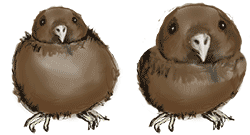 3. The Ravenous Bird. This is a small brown bird whose only habit is to come and tap your window furiously, asking for food. That's all it does. You can put food out, and watch all the other birds gobble it up, but you will never see the ravenous bird help itself. Five minutes later it will be back, banging on the window again. Experts are divided into those who think it is very stupid and those who think it enjoys being hungry. Personally, I think it probably just likes tapping windows and seeing householders run about with sunflower seed.
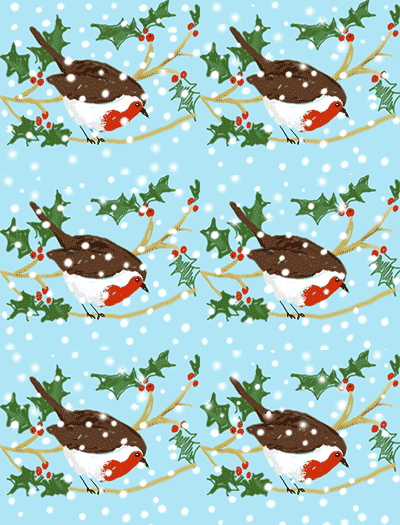 4. The Christmas Card Bird. This is a cross between a robin and a fashion model. It sits around photogenically on logs, wheelbarrows, sundials, spades, etc, trying to catch the last rays of wintry sunshine and look desperately glamorous. Don't try to feed it. It's on one of those trendy new diets and is trying to starve to death. It is kept going through the winter by the warmth of its ego.
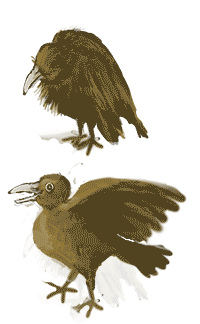 5. The Manic Depressive Garden Bird. Sometimes you see little birds shooting across your garden at about 200 mph, which seems an excessive speed just for a local trip. You also see little birds crouching in trees for hours on end, gloomily staring into space through half-closed eyelids. Believe it or not, they are the same bird. They're just having a bit of a mood swing. It is as if they start off the day on a high, and then suddenly remember having heard David Attenborough say, on one of those interminable afternoon repeats, ‘It seems amazing that even a small bird has to consume over five times its body weight every day just to survive!’ and been so depressed by the thought that they sink into an ineffable Weltschmerz.
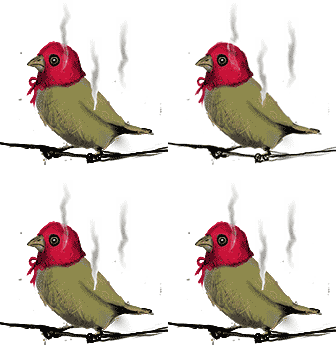 6. Self-Steaming Finch. This bird can easily be recognised on a winter's day as it is always totally stationary. It sits on a branch, or telephone wire, or roof, or even a bird table, and just stays there. After a while a faint but perceptible mist begins to form above its head, tiny but real. It is steaming. It gives off body heat like any animal, and because it is not going anywhere, the heat turns into steam. It reminds one of those little birds one sometimes sees in the windows of Chinese restaurants in Soho's Gerrard Street, turning on a spit, or is one thinking of those little birds which only the Italians have a taste for eating? Well, in any case the self-steaming finch is pursuing an entirely different method of keeping warm from any other bird except, perhaps, the penguin. Most birds think you have to keep moving to keep warm. This bird thinks that moving is all very well, but it eats up energy, and staying still is a lot better. What would make its life complete would be if someone knitted it a tiny balaclava.
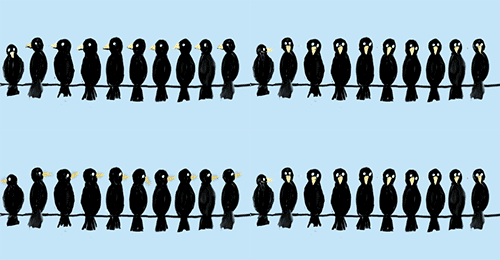 7. The Telegraph Reader. From time to time you see rather stream-lined and interesting-looking birds sitting all by themselves on telegraph wires. They have a thoughtful air, as if they are saying to themselves, ‘I wonder why it is that humans call them “telegraph" poles, when they are actually telephone poles... Actually, I wonder if most of them even know what a telegraph is... '
But they are not thinking anything like that at all. What they are thinking is: ‘For heaven's sake, where is everyone?’ The reason they are thinking this is because they are migrating birds who have turned up too late for the great migration. Unaware of this, they have been sitting on the wires all winter waiting for the exodus to begin, and the awful truth is beginning to dawn on them that they missed the whole thing and that everyone else has been in Egypt for two months. Now they will have to stay in Britain the whole winter. No wonder they are looking thoughtful.
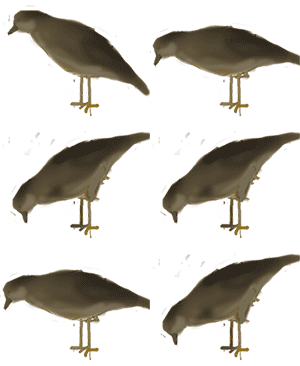 8. Mrs Blackbird. A male blackbird is unmistakable. He is black with an orange beak. No other bird can claim this. But Mrs Blackbird is different. She is brown and nondescript and looks like many another bird, such as a thrush, a linnet, a nightingale, a cuckoo and so on. Make no attempt to distinguish between them. They are all henceforth female blackbirds.
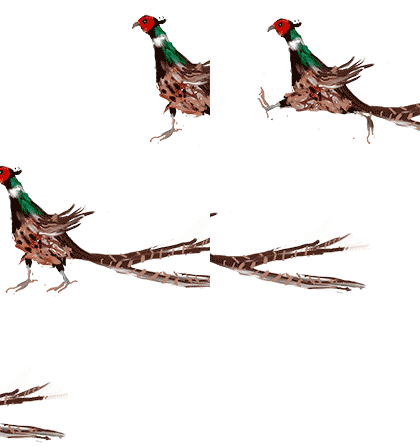 9. The Country Magazine Cover Bird. At this time of year all country magazines like to put a proud game bird on the front to look festive. They
have probably just slipped round to the nearest butcher and bought a dead one to take a snap of, and if your idea of a festive cover is a snap of a dead bird, then why not ? But these birds are not wholly confined to glossy prints - in real life they also occasionally wander, live, into your garden, relieved to get away from the traffic. You will know it has happened because you will hear one of your family shriek out: ‘Oh, look, in the garden - it's a pheasant, no a grouse, or do I mean a ptarmigan or capercailzie, if that is how it is pronounced ...’ By the time anyone else has come to have a look the country magazine cover bird will have vanished again.
9. The Country Magazine Cover Bird. At this time of year all country magazines like to put a proud game bird on the front to look festive. They
have probably just slipped round to the nearest butcher and bought a dead one to take a snap of, and if your idea of a festive cover is a snap of a dead bird, then why not ? But these birds are not wholly confined to glossy prints - in real life they also occasionally wander, live, into your garden, relieved to get away from the traffic. You will know it has happened because you will hear one of your family shriek out: ‘Oh, look, in the garden - it's a pheasant, no a grouse, or do I mean a ptarmigan or capercailzie, if that is how it is pronounced ...’ By the time anyone else has come to have a look the country magazine cover bird will have vanished again.
` (It is also widely found on dinner plates, staring up at you unwinkingly and somewhat unnervingly as you eat your way through the main course. )
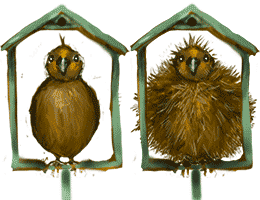 10. The Bird Table Bird. This bird is only found on bird tables. Sometimes it eats, but mostly it just sits and puffs itself up, fluffing out its feathers. It fluffs up its feathers not so much to keep warm as to look bigger. It always fails. What it doesn't realise is that every other bird fluffs itself up in winter as well, so that all birds get bigger in winter-time. And thus all stay relatively the same size.
Well, that's it. Your winter bird-spotting troubles are over! There is sometimes thought to be an eleventh kind of bird, one that flies overhead so high that it must have its own oxygen supply and be heading to New York as the 1215 flight out of Heathrow, but it is safe to treat this just as one of the other ten which happens to be out of focus. Good spotting!
The INDEPENDENT DECEMBER 1ST & 2ND 1993
animated illustrations by Wendy Hoile © 2014